
The Network Effect • A Monthly Newsletter • Issue No. 3 • October 2026
The Member Who Came Back 40 Points Cleaner
Borrowers are erasing real debt with fake identity theft claims. A single application review rarely catches it.

By Jen Lamont, Credit Union Fraud Strategist
7 minute read
Hi fraud fighters. I’m back with Issue No. 3 of The Network Effect. This month: a member who reapplied for an auto loan and came back with a credit file forty points cleaner than the one that got her declined eight months earlier. It wasn’t identity theft. It was credit washing.
I’ll walk through the pros and cons of fighting fraud with your memory, and five checks you can run today with the tools you already have. There’s also a swimming pool I still think about, and what Frank McKenna found when he started tracing where all the CFPB complaints are coming from.
New here? Subscribe to get the next issue in your inbox.

A member reapplies for an auto loan eight months after being declined. Same job, same income, same address, but the file looks nothing like it did in February. Two charge-offs and a collection account that tanked her score are just gone, replaced by a clean report and a score forty points higher. The dispute reason on file: identity theft. Nothing else in her history changed, just the car she wanted.
It wasn’t identity theft. It was credit washing, and the loan officer only caught it because he happened to remember her name from the decline eight months earlier.
How many of us are relying on our memory to fight fraud? It’s not a bad tool, but it can be an inconsistent one, for sure. Some days I can’t remember something that happened the day before, and some days I remember a pool I looked at in an investigation three months ago. Hit or miss.
Déjà Pool
My memory often fails me, but not in the case I’m about to share with you. I was reviewing a loan application one afternoon and took my normal investigative route to see if I could make heads or tails of it. I put the applicant’s address into Google, and an apartment complex in Texas popped up. The applicant said they paid $1,500 a month in rent. I started looking at the average price of an apartment in the complex, and my eyes fixated on the outdoor pool. It was gorgeous. It was so memorable that I knew I had seen it before.
I took the address and typed it into our loan operating system to see if we had any previous applications linked to that complex. BINGO. We sure did. Three months prior, I had investigated and denied a loan application for fraud concerns. Once I could compare the two applications, it was pretty easy to determine they were both fraudulent. Individually, each one was a bit of a challenge. Side by side, it was obvious.

Sorry, I got sidetracked by my fraud investigation nostalgia. Back to credit washing.
The Hidden Cost
No loss hit the books in the case above, but the cleanup wasn’t free. The team pulled the original application, compared trade lines line by line, and flagged the file for manual underwriting review. That’s work that doesn’t show up in any loss report but eats a Tuesday afternoon all the same.
If the loan had already funded, the real bill would have shown up months later: a borrower who never qualified for the rate or the term she got, missed payments that looked like ordinary delinquency instead of the fraud they were, and a charge-off nobody connects back to a scrubbed file until someone goes looking.
That’s the trouble with credit washing. It doesn’t announce itself. It just quietly changes who your underwriting thinks it’s looking at.
Reduced Requirements. More Exploitation.
Credit washing exploits a system built for real victims. Since federal rules stopped requiring a police report to dispute a trade line, the process has gotten faster and easier to run at scale. The credit report your underwriting relies on can look nothing like the borrower’s real payment history by the time the application lands on your desk.
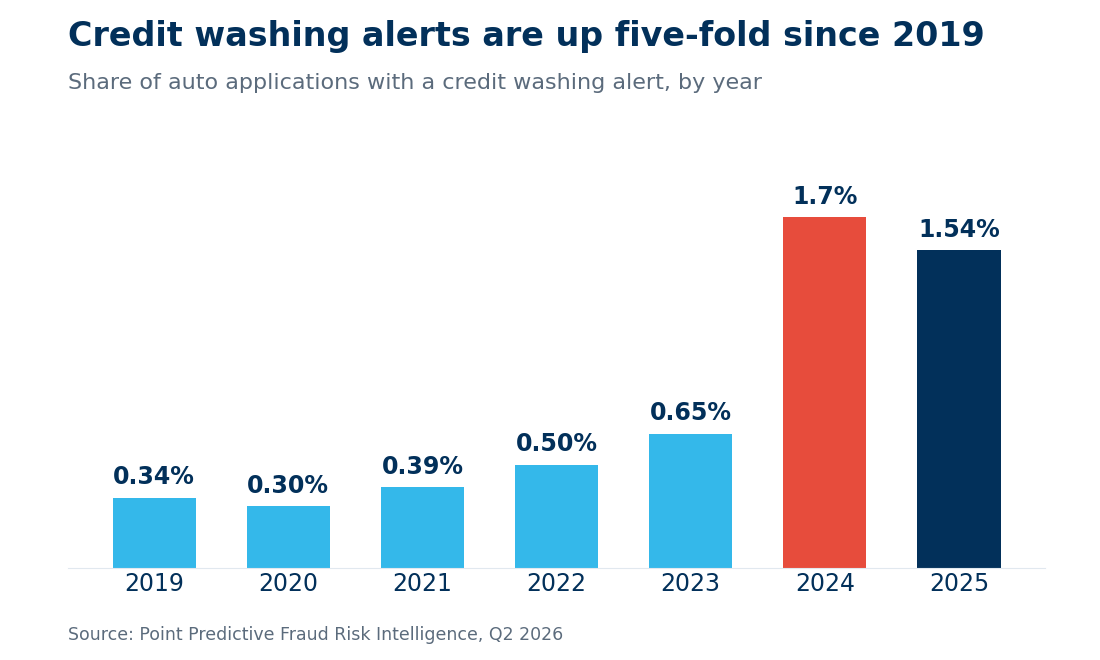
Point Predictive’s latest Fraud Risk Intelligence report puts numbers on what I’m describing. Credit washing alerts on auto applications rose five-fold between 2019 and 2024, peaking at 1.7% of all applications, and held at 1.54% in 2025, still nearly five times pre-2022 levels. The manipulation is temporary and nearly invisible without tools built to catch it, which is exactly why a single-application review misses it every time.
“It’s hard for credit unions and lenders to counterattack credit washing because it’s being driven ever higher by credit repair gurus touting new ways to use AI to erase bad debt.”
Frank McKenna, Point Predictive co-founder
Copy. Paste. Complain.
The CFPB complaint database is also part of the rise in credit washing. Frank’s recent digging into the database made me stop and really think about the process, and about how many recent complaints are even real. He traced a complaint filed against Experian in February 2024 that opens with an oddly poetic line about a “sudden jolt” shattering the “tranquility” of everyday life. Over the following 309 days, more than 5,000 other consumers in 32 different states filed that exact same complaint. Not a similar story. The same sentences, word for word.
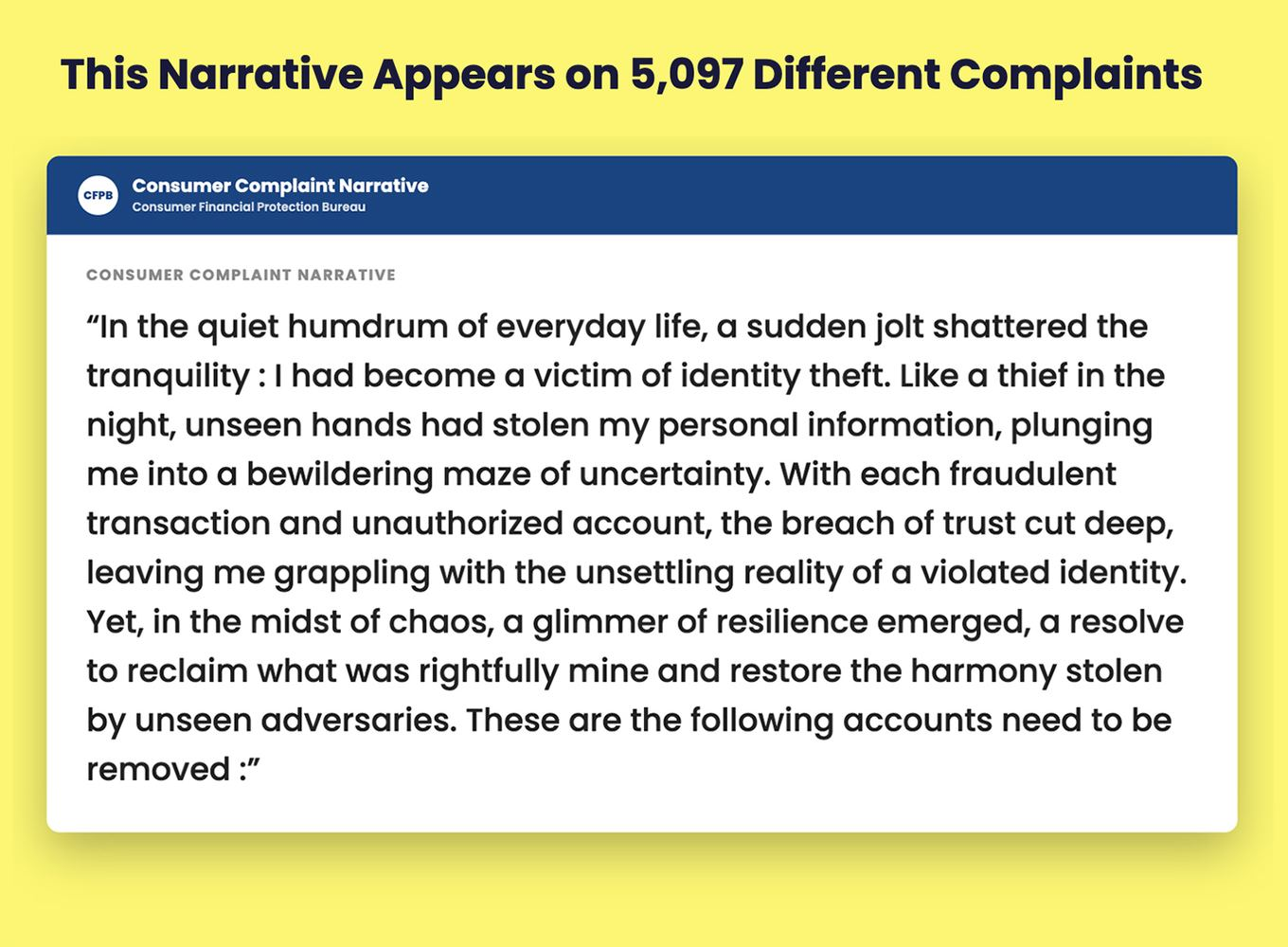
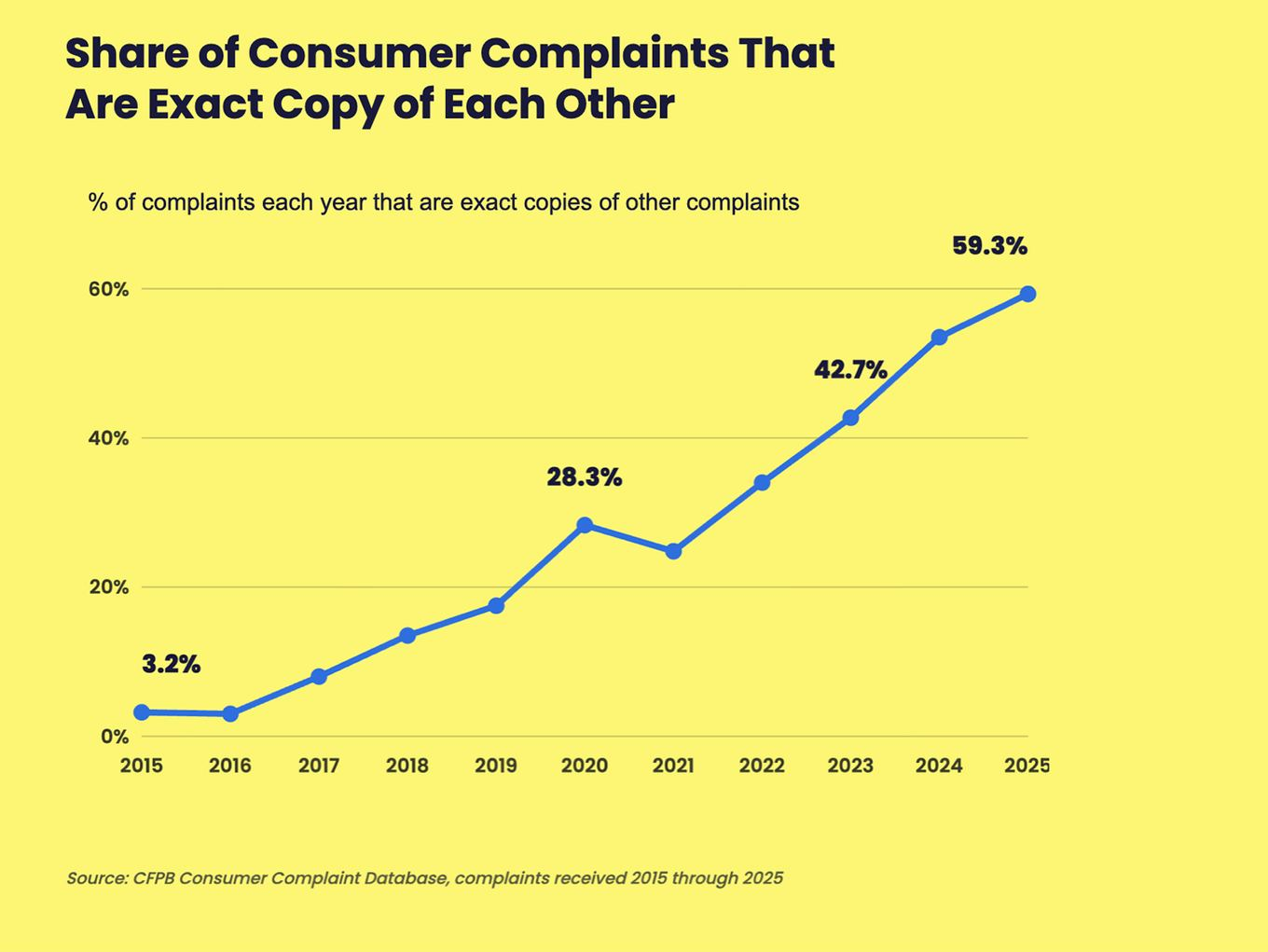
That’s not 5,000 people independently reaching for the same language to describe their identity theft. That’s a template that spread across two-thirds of the country in under a year, and it’s not an outlier. Frank found that nearly 60% of published complaint narratives in 2025 matched another complaint word for word, up from about 3% a decade ago.
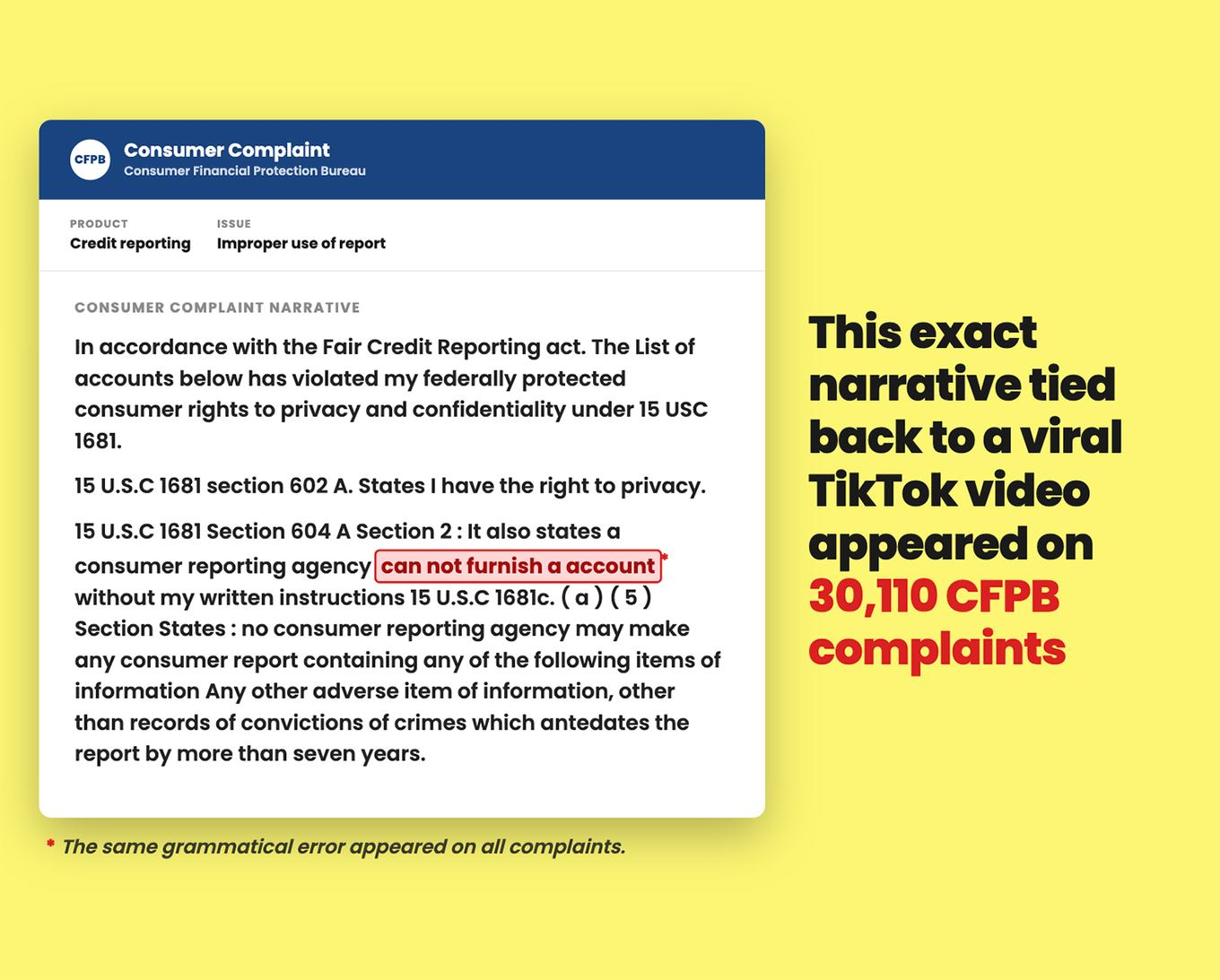
These templates spread like wildfire through viral TikTok videos and sell in “credit sweep” packages for $5 to $15. One template, typo and all, landed on 30,110 complaints.
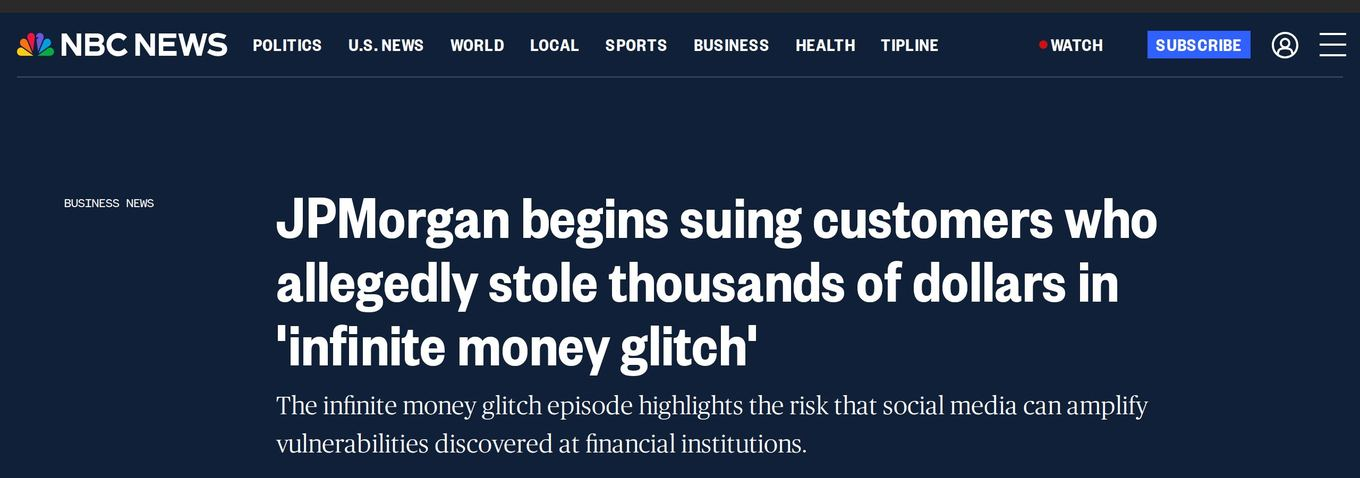
It’s the Chase “glitch” from a couple of years ago all over again. That one was actually a detailed account of how to commit check deposit fraud, but who am I to tell the social media community that a “glitch” is really just blatant fraud? It ended in lawsuits. Social media being used to spread misinformation or bad trends is not new; it just seems to keep getting worse. Remind anyone who will listen that if something sounds too good to be true, it likely is.
One bit of good news: the CFPB has started pushing back. Complaints about credit disputes went from about 80,000 a month in 2023 to a record 520,000 a month by January 2026, and the bureau now requires filers to verify their identity and sign an attestation that the complaint is true. Frank covered the changes here. It won’t stop the washers, but it slows them down.
What You Can Actually Do. No New Tools Required.
Five checks you can run today, practitioner to practitioner:
Ask the follow-up question. A genuine identity theft victim can usually tell you when they noticed it, what they did about it, and what account was involved. A coached answer is vague or oddly rehearsed. Two minutes of conversation surfaces more than the report alone. Don’t be afraid to pick up the phone and call.
Watch for the score-jump-and-shrink combo. A meaningful score increase paired with fewer reporting trade lines in a short window is the clearest manual tell there is.
Loop in collections before you approve, not after. A five-minute internal check: has anyone seen this member’s name, and is there a recently disputed charge-off? That conversation can catch what the credit bureau alone won’t show you.
Slow down on the “surprisingly clean” reapplicant. A member declined or charged off in the last year who comes back with a noticeably better file has earned a manual look, not an automatic re-approval.
Train frontline staff on the CPN tell. A member mentioning a “credit privacy number” or a “secondary credit file” is describing a product built to wash credit, not protect it. That phrase alone should route the application for review.
The Bottom Line
Credit washing doesn’t require a ring, a fake identity, or any of the infrastructure synthetic fraud needs. It just requires a dispute form and a system that takes it at face value. Catching it doesn’t require new infrastructure either. It mostly requires someone remembering to ask the right question before the score does the talking.
Every file you catch before funding is one less loan quietly built on a credit history that isn’t real. Access to consortium data can make this process more automated and a lot more accurate, but there are things you can do today without any fancy tools or tech.
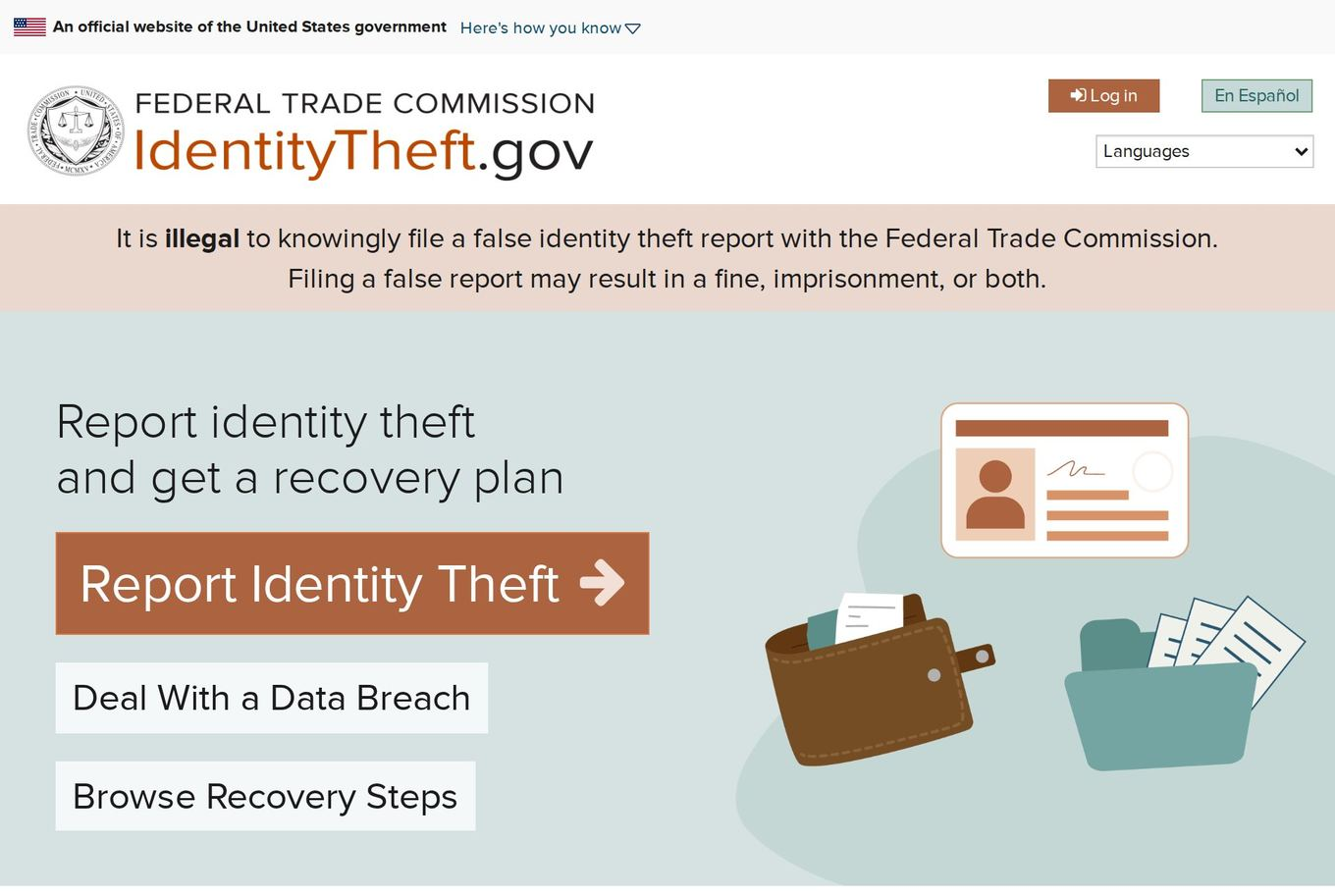
Sources: Point Predictive Fraud Risk Intelligence, Q2 2026. FrankonFraud, Aug. 17, 2026. FrankonFraud, Feb. 6, 2026. NBC News. IdentityTheft.gov.
Meanwhile, at Point Predictive
Everything above about credit washing comes from our Q2 2026 Fraud Risk Intelligence report, which covers eleven other trends too, including the seasoned synthetics from last issue. Download the report.
Frank and the team found 1,300 cloned dealer websites built to lure buyers and lenders, and have gotten 600 of them taken down so far. Read how they did it.
If you want the full-year picture for your next fraud committee meeting, the 2026 Auto Lending Fraud Trends Report is the one to bring. Get the report.
Let’s Talk
Caught a washed file, or had one slip past you? Email me and it comes straight to my inbox. Tell me what you’re seeing, what’s keeping you up at night, or what you’d argue about over coffee. I read everything, and reader questions will shape future issues.
Email JenWorking a case that needs more than a newsletter? Contact our fraud team and someone will get back to you.
And if you know someone else in the credit union world who’d get something out of this, send it their way. They can subscribe here to get the next issue directly.
Until next month, keep comparing notes. It’s how we win.
Jen Lamont
Credit Union Fraud Strategist, Point Predictive
Jen Lamont is Credit Union Fraud Strategist at Point Predictive, where she helps credit unions take their fraud prevention programs to the next level with AI and data. She brings more than 20 years of fraud experience from America’s Credit Union and Washington State Employees Credit Union, covering card fraud, complex investigations, identity theft, account takeovers, chargebacks and recovery, and BSA compliance. Jen is a Certified Fraud Examiner and holds the CBSAP certification through America’s Credit Unions. In 2024, she won the Knoble Award for her work protecting older Americans from financial scams. If you spend any time in the fraud world, you’ve probably heard her. She’s a regular guest on many of the industry’s most popular fraud podcasts and a frequent speaker at conferences, where she shares best practices with credit unions across the country.
Get the next issue first
The Network Effect lands roughly once a month. No spam, no sales pitch. Unsubscribe anytime.
Get the next issue first
The Network Effect lands roughly once a month. Fraud advice for credit unions, from someone who sat on your side of the desk.
No spam, no sales pitch. Unsubscribe anytime.
Talk to the fraud team
Tell us what you’re working on and someone from the Point Predictive fraud team will get back to you.
