
The Network Effect • A Monthly Newsletter • Issue No. 1 • August 2026
From One Side of the Desk to the Other

By Jen Lamont, Credit Union Fraud Consultant
6 minute read
A quick note before we get into it: this is the first issue of a newsletter. About once a month I’ll share what I’m seeing in credit union fraud. Less a polished article, more the notes I’d pass along if we were comparing cases over coffee. Subscribe to get the next issue in your inbox.
My background is BSA and fraud. I spent two decades at credit unions fighting fraud and making sure we didn’t just comply with the Bank Secrecy Act, we made the data matter. No box-checking.
I wrote SAR narratives late into the evening because the story deserved to be told right. I sat across from examiners and defended risk decisions. I trained frontline staff to trust their gut when a member’s story didn’t add up. I’ve lived and breathed this work most of my adult life, and I wouldn’t have it any other way.
But things change. They always do.
I’m still fighting fraud, just from a different seat. I’ve recently joined the team at Point Predictive, home of the largest lending fraud data consortium in the United States. And with that data, we’re stopping fraud losses at a pace I never could have imagined from behind one institution’s walls. The first few weeks here felt like being handed binoculars after twenty years of squinting.
If you’ve spent time in a credit union fraud or BSA role, you know the feeling I’m describing. I felt it more times than I can count. You catch something. You work the case. You file the SAR. And then you wonder how many other institutions that same fraudster hit before you found them, and how many they’ll hit after. You did your job well, and it still wasn’t enough to stop the scheme. That gap between what one institution can see and what the fraud actually looks like is the reason this newsletter exists.
My plan is simple: take everything twenty years in the trenches taught me and put it to work for all of us.
Why I Named It The Network Effect
The name isn’t an accident. A network effect is what happens when something gets more useful as more people use it. Think about telephones. If you owned the only one on earth, it would be useless. Once your neighbor got one, you could actually call somebody. And once a hundred million people had them, the phone changed how the world worked. Fraud data works exactly the same way: one lender’s charge-off is a loss. That same record, shared across thousands of lenders, is a warning.
Fighting fraud works the same way. One institution’s watch list protects one institution. A shared network of intelligence, fed by hundreds of lenders, protects everyone in it. That’s the idea I keep coming back to: together, we’re smarter than any one of us is alone. You’ll see it in every issue I write.
This first issue is a little different from what future ones will be. Before we get into fraud typologies, case breakdowns, and tactics you can put to work, I want to start with the basics: what consortium data actually is, why it works, and why I believed in it enough to build this chapter of my career around it.
What Is Consortium Data and Why Should You Care?
Ever wish you could see an applicant’s history across every lender they’ve touched, not just your own? That’s consortium data. That’s the whole idea.
Here’s how it works. Lenders share what they’re seeing on applications: income claims, employer information, identity details, application outcomes. All of it gets pooled, and patterns surface that no single institution could ever spot alone. The borrower who inflated their income at three other credit unions before walking into yours? The consortium already knows.
Think neighborhood watch, but for lending fraud. One household spotting something suspicious is useful. Every house on the block comparing notes in real time? That’s a whole different animal.
Here’s what that looks like in practice. A fake employer on a single loan application is nearly impossible to catch. The name sounds plausible, the paystub looks clean, and the phone number connects to someone happy to confirm the “job.” But when that same made-up employer shows up on forty applications across a dozen lenders in three states, it stops being an application and starts being a fraud ring.
That’s how Point Predictive has flagged more than a billion dollars in application fraud tied to fake employers. No single lender saw the whole picture. The network did.
Why Your Data Alone Isn’t Enough
Your historical data matters, but it only shows you what you’ve already seen. Fraudsters don’t stick to one institution. They move, they adjust, they test. By the time a pattern shows up in your data, you’ve already taken the loss. I learned that one the hard way, more than once.
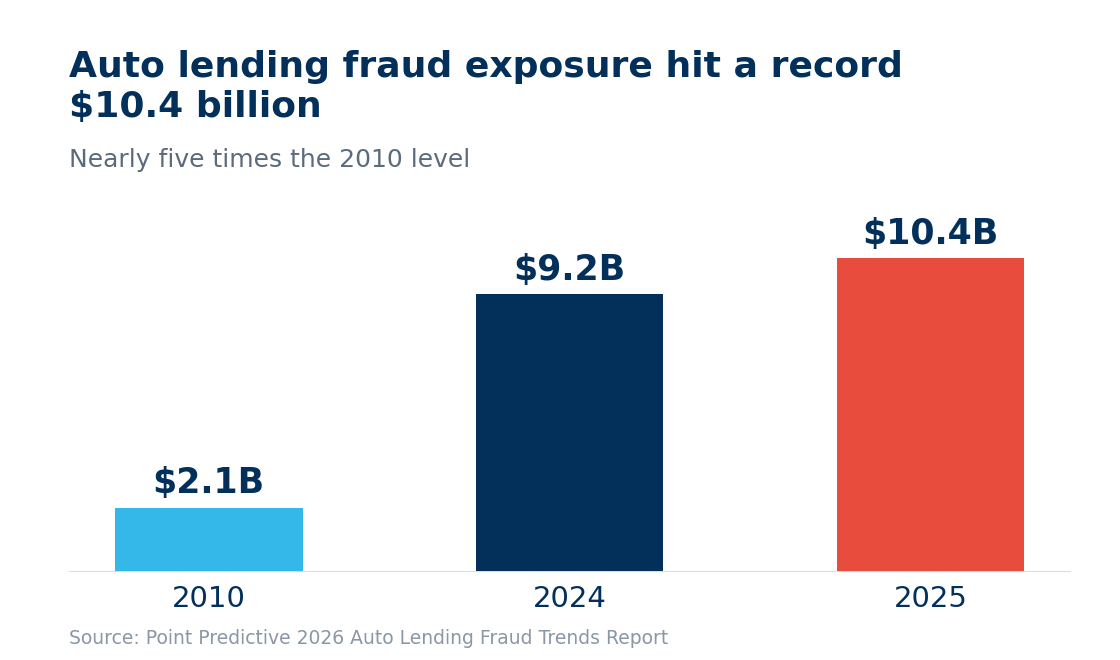
The numbers back this up, and they are not pretty. Point Predictive’s 2026 Auto Lending Fraud Trends Report put fraud exposure in auto lending at a record $10.4 billion, up from $9.2 billion the year before and nearly five times what it was in 2010.
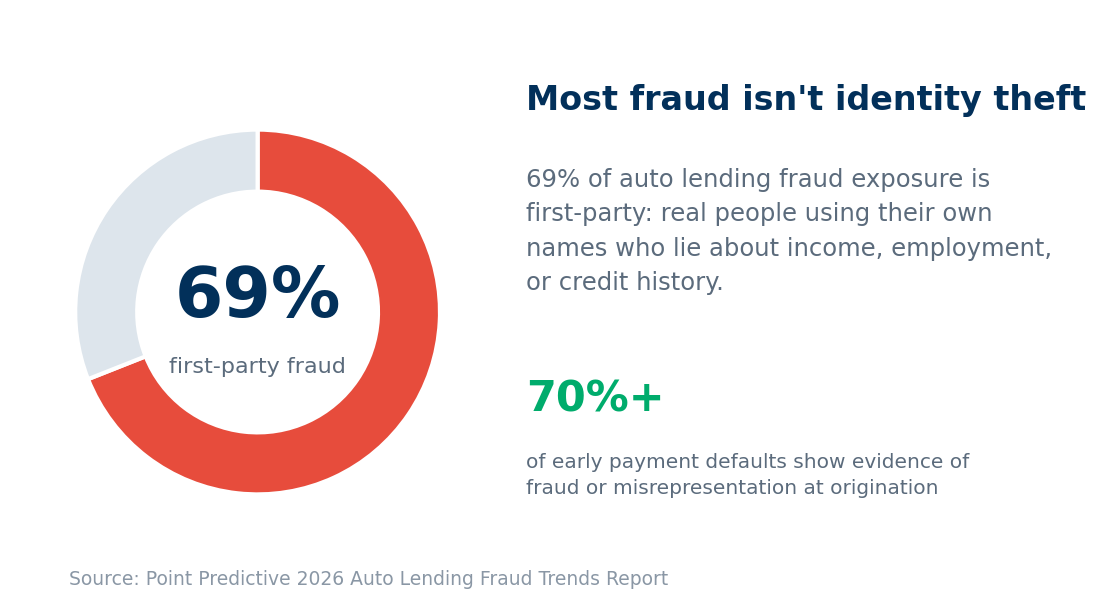
And here’s the part that should get every credit union’s attention: 69 percent of that exposure is first-party fraud. Not stolen identities. Real people using their own names who lie about income, employment, or credit history to get a loan they couldn’t get honestly.
First-party fraud is the kind your own data has the hardest time catching. A stolen identity might trip an alert. A member who inflates their income by $30,000 looks like a normal application right up until they default on their loan payments.
The same report found that more than 70 percent of early payment defaults show evidence of fraud or misrepresentation at origination. Go back and read that one more time. I’ll wait. Most of the loans that go bad in the first few months were never going to perform. The lie was baked in on day one, and one institution’s data had no way to see it.
Bust-out fraud tells the same story from a different angle. It has grown 67 percent over the past five years, and the whole scheme depends on speed: hit as many lenders as possible before any one of them reacts. It’s fraud built to exploit the blind spots between institutions. You can’t catch it alone, because alone, you only ever see one piece of it.
A consortium flips that equation. Every flagged application, every misrepresentation identified, every documented bust-out scheme feeds a shared memory across the industry. And that memory gets smarter with every lender that joins.
The More Lenders, the More Powerful It Gets
Consortium data doesn’t just add up. It compounds.
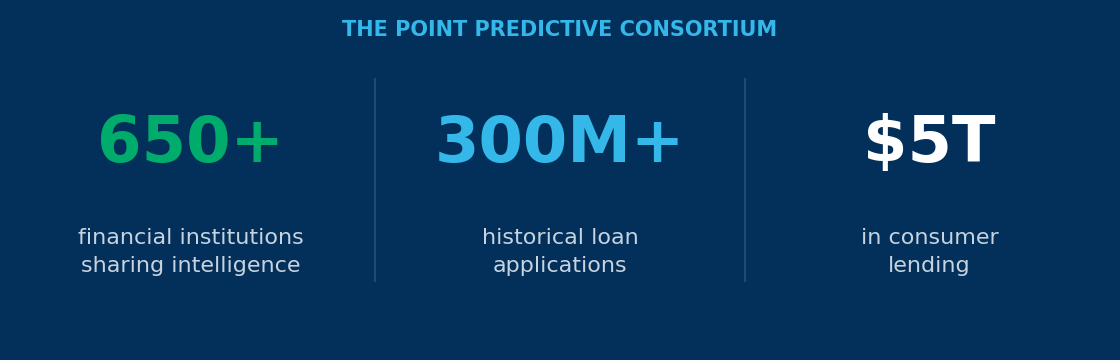
Point Predictive’s consortium now includes more than 650 financial institutions and draws on over 300 million historical loan applications tied to roughly $5 trillion in consumer lending. The scale matters, but the mix is what does the heavy lifting: different markets, different fraud tactics, different risk profiles. A scheme tested against a fintech in Phoenix gets recorded, and a credit union in Ohio is protected from it without ever having seen it.
For credit unions, this matters more than for almost anyone else. Fraud rings target credit unions and community banks on purpose. They’re betting your detection is thinner than the big banks’, that your team is smaller, that your culture of member trust can be used against you. I watched it happen from the inside for twenty years. It made me angry then. It still does. Consortium data calls that bet. It gives a $500 million credit union the same view of fraud that a top-ten auto lender has, because they’re both looking at the same shared intelligence.
What It Means for You
You don’t have to see the fraud yourself to be protected from it. That’s the whole point of shared intelligence: it shows up at the decision, not after it.
Think about what that does to your timing. The risk is in front of you at the application, not in a file you’re reconstructing after the default. A fraudster who gets caught at one institution doesn’t get five clean shots at four more. And your team isn’t playing defense with yesterday’s information. You’re working with what the entire network learned this morning.
Consortium data works. The real question is who has access to it.
What’s Coming in Future Issues
The Network Effect will land in your inbox roughly once a month, and future issues will read more like a working tool than an introduction. Expect deep dives on specific fraud typologies, things like income and employment misrepresentation, credit washing, synthetic identity, and dealer-driven fraud. Expect breakdowns of real schemes and how they were caught.
Expect practical material you can bring to your next fraud committee meeting or your next audit or exam. And expect me to be honest about what I got wrong over twenty years, because those lessons taught me more than the wins did.
If there’s a topic you want covered, tell me. This will be a better newsletter if it’s a conversation instead of a broadcast.
Let’s Talk
I mean it about the conversation. Email me and it comes straight to my inbox. Tell me what you’re seeing, what’s keeping you up at night, or what you’d argue about over coffee. I read everything, and reader questions will shape future issues.
Email JenWorking a case that needs more than a newsletter? Contact our fraud team and someone will get back to you.
And if you know someone else in the credit union world who’d get something out of this, send it their way. They can subscribe here to get the next issue directly.
Until next month, keep comparing notes. It’s how we win.
Jen Lamont
Credit Union Fraud Consultant, Point Predictive
Jen Lamont is Credit Union Fraud Consultant at Point Predictive, where she helps credit unions take their fraud prevention programs to the next level with AI and data. She brings more than 20 years of fraud experience from America’s Credit Union and Washington State Employees Credit Union, covering card fraud, complex investigations, identity theft, account takeovers, chargebacks and recovery, and BSA compliance. Jen is a Certified Fraud Examiner and holds the CBSAP certification through America’s Credit Unions. In 2024, she won the Knoble Award for her work protecting older Americans from financial scams. If you spend any time in the fraud world, you’ve probably heard her. She’s a regular guest on many of the industry’s most popular fraud podcasts and a frequent speaker at conferences, where she shares best practices with credit unions across the country.
Get the next issue first
The Network Effect lands roughly once a month. No spam, no sales pitch. Unsubscribe anytime.
Get the next issue first
The Network Effect lands roughly once a month. Fraud advice for credit unions, from someone who sat on your side of the desk.
No spam, no sales pitch. Unsubscribe anytime.
Talk to the fraud team
Tell us what you’re working on and someone from the Point Predictive fraud team will get back to you.
